University of North Texas

- About Us
- Undergraduate Studies
- Graduate Studies
- Back
- Graduate Studies
-
- Apply to the Graduate Program in History
- Master's Program
- Online Teachers Program
- PhD Program
- Scholarships, Funding & Financial Aid
- Faculty Concentrations and Categories
- Facilities
- Graduate Course Catalog
- Student Profiles
- Placement
- Graduate Student Handbook
- Graduate Student Forms
- Contact Graduate Program Personnel
- People
- Department
- Events
- Forms
- Donations
- Alumni
-
- Back
- Graduate Studies
-
- Apply to the Graduate Program in History
- Master's Program
- Online Teachers Program
- PhD Program
- Scholarships, Funding & Financial Aid
- Faculty Concentrations and Categories
- Facilities
- Graduate Course Catalog
- Student Profiles
- Placement
- Graduate Student Handbook
- Graduate Student Forms
- Contact Graduate Program Personnel
- People
- Events
- Search:
-
- Quicklinks:
Executive Council Discussion Series Lectures
Executive Council Discussion Series Lectures
- About the Center
- Air Power Symposium
- Alumni
- Annual Hurley Military History Seminar
- Annual War Studies Symposium
- Executive Council
- Executive Council Discussion Series Lectures
- MHC Course Rotations
- Student Fellows
- United States Air Force Fellows
- UNT Faculty Fellows
- UNT Press
- West Point Fellows
- Tejanos & Wars Podcast
Topics and Speakers:
2021 - Present
Fall 2025
The Fall 2025 Executive Council Discussion Series Lecture, "70 Years Above 70,000 Feet! A History of Reconnaissance Flights,” was presented by Lionel "Stormy" Boudreaux.
Stormy, a member of the Executive Council of the MHC, earned a B.S. from Tulane University before becoming a US Air Force pilot in 1968. He was a reconnaissance pilot during the Cold War and Vietnam and retired in 1992 with 687 combat hours and over 6,000 total logged flight hours, 1,500 of which were flown above altitudes of 70,000 feet. Stormy was one of only 12 pilots in history who flew operational sorties in both the U-2 and the SR71. He later earned an M.S. in aeronautics from Embry-Riddle Aeronautical University and currently works as an engineer at Lockheed Martin.
Fall 2024 - Spring 2025
In the 2024-2025 academic year, MHC did not organize Executive Council Lectures. Instead, it organized two state-of-the-field events, inviting four distinguished historians to campus. In the Fall, it organized “Perspectives on Military History: a Panel.” The speakers were Ruth Lawlor from Cornell University and Michael Neiberg from the U.S. Army War College. In the Spring semester, MHC organized “Military History: The State of the Field.” The speakers were Kara Dixon Vuic from Texas Christian University and Lei Duan from Sam Houston State University.
Spring 2023
The Spring 2023 Military History Center Executive Council Discussion Series Lecture, "The Limits of Power Projection: US Capabilities and Constraints," was presented by Colonel Jeremy Reeves, United States Air Force and UNT PhD candidate. Colonel Reeves is an Air War College Fellow at the University of North Texas. He specializes 20th century American military history and is studying under Professor Wawro. Col Reeves is a command pilot with over 3,400 flight hours, primarily in KC-10 Extender. His twenty-two-year career includes serving as an operations officer and commander of a flying squadron and staff assignments at the Air Force major command and Joint Combatant Command level. Before beginning the PhD program at UNT, he served as the Vice Wing Commander of the 380th Air Expeditionary Wing at Al Dhafra Air Base, United Arab Emirates. A graduate from Texas Tech University, Col Reeves earned masters degrees from the Naval Postgraduate School and the Naval War College. Upon completion of the PhD fellowship at UNT, he will join the faculty at the Air War College. His talk explained the ability of the United States to move combat assets to the Indo-Pacific region in the case of a Sino-American war. occaecat ex.
Fall 2022
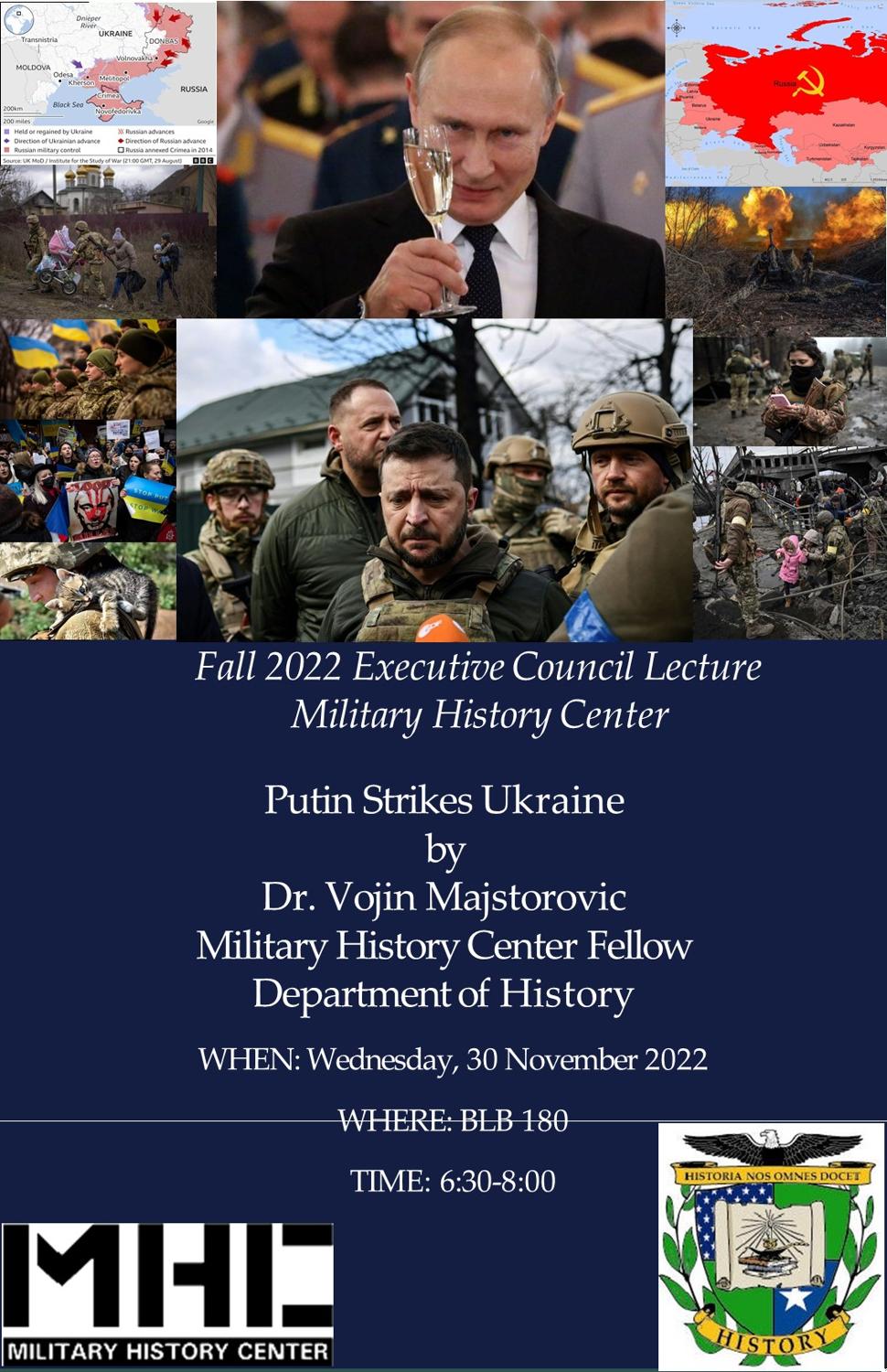
The Fall 2022 Military History Center Executive Council Discussion Series Lecture,"Putin Strikes Ukraine," was presented by Dr. Vojin Majstorovic on 30 November 2022. Dr. Majstorovic discussed the roots of the Russia-Ukraine War and speculated on the possible course it could follow.
Spring 2022
The Spring 2023 Executive Council Discussion Series Lecture, "The Limits of Power Projection: US Capabilities and Constraints," was presented by Colonel Jeremy Reeves, United States Air Force and UNT Ph.D. candidate. His talk explained the ability of the United States to move combat assets to the Indo-Pacific region in the case of a Sino-American war.
Colonel Reeves is an Air War College Fellow at the University of North Texas and specializes in 20th century American military history. He is a command pilot with over 3,400 flight hours over the course of his twenty-two-year career. He has served as both an operations officer and commander of a flying squadron and has taken staff assignments at the Air Force major command and Joint Combatant Command level. Before beginning the Ph.D. program at UNT, he served as the Vice Wing Commander of the 380th Air Expeditionary Wing at Al Dhafra Air Base, United Arab Emirates. A graduate from Texas Tech University, Col. Reeves earned Masters degrees from the Naval Postgraduate School and the Naval War College. Upon completion of his Ph.D. fellowship at UNT, he will join the faculty at the Air War College.
2016 - 2020
Fall 2019
Fall 2019 Executive Council Discussion Series Lecture was held on 21 October 2019. The speaker was Terry L. Thorsen, who discussed his book, Phantom in the Sky: A Marine's Back Seat View of the Vietnam War (2019), published by UNT Press. The book chronicles Thorsen’s active-duty Marine Corps experience in Vietnam with the oldest and most decorated fighter squadron in the Marine Corps, the Red Devils of VMFA-232.
Between 1966 and 1970, Mr. Thorsen flew 123 combat sorties, earning ten Air Medals, one Bronze Star Award, two Navy Unit Commendations, the Vietnam Service Medal, the Vietnamese Cross of Gallantry with Palm, and the Vietnam Campaign Medal with Device. He is a member of the Military Officer's Association of America and was recently inducted into the Military Order of the World Wars.
Spring 2019
The Spring 2019 Executive Council Discussion Series Lecture brought Dr. Erica Charters to campus on 30 April 2019 to present "Global War and Disease: The Making of Modern Bodies."
Dr. Charters is Associate Professor of Global History and the History of Medicine at the University of Oxford. Her research examines the relationship between war and disease, particularly in colonial contexts. She received her M.A. in History at the University of Toronto before receiving her DPhil at the University of Oxford.
Dr. Charters has over ten publications and has been awarded multiple recognitions for her work. Her monograph, Disease, War, and the Imperial State: The Welfare of British Armed Forces during the Seven Years War (2014), was awarded the George Rosen Prize by the American Association for the History of Medicine and the Templer Medal for Best First Book by the Society for Army Historical Research. Her chapter in Health and Medicine at Sea, 1700–1900 (2009), titled ‘The Intention is Certain Noble’: The Western Squadron, Medical Trials, and the Sick and Hurt Board during the Seven Years War, received the Julian Corbett Prize for Research in Modern Naval History. Additionally, she co-edited the interdisciplinary volume Civilians and War in Europe, 1618–1815.
More broadly, Dr. Charters is interested in the relationship between war and civil society during the early modern period. One of her current research projects is on the history of prisoners of war. You can read about some of her research on her research blog, https://warhistory.blog/.
Fall 2018
The Fall 2018 Military History Center Executive Council Discussion Series Lecture brought Mr. Rick Sanchez to campus on 5 December 2018. He presented "BROTHERS TO THE RESCUE: The Tragic End of a Humanitarian Organization." He discussed the daring missions of Brothers to the Rescue and the history that led to the desperate plight of Cuban refugees trying to flee communist Cuba. The "Brothers" would strap into their Cessna O-2 Skymasters and fly long arduous missions in search of Cuban rafters seeking freedom in the U.S. and then relaying their positions to U.S. Coast Guard vessels. He explained the events that lead to the death of 4 pilots and the eventual dissolvement of the group. Mr. Sanchez was born in 1968 in Miami, FL to Cuban immigrant parents, and has college degrees in English, aviation, and environmental studies. His 30+ years' involvement with aviation includes training thousands of pilots from over 60 countries. He has been a park ranger for 15 years on federal and state lands. He worked on the historical restoration of a North American AT-6, and did historical aircraft and military research for various museums and organizations. He was involved in the aviation archaeological discoveries of a Douglas AD-4 Skyraider and a North American F-100 Super Sabre that had crashed in the Everglades. Rick served as observer, pilot, and/or instructor for the Brothers to the Rescue organization, our August topic, in Cessna O-2 Skymasters. He is a program manager at Ameriflight, LLC, a cargo airline at DFW, and an adjunct aviation professor at Tarrant County College.
Spring 2018
The Spring 2018 Executive Council Discussion Series Lecture, "Elvis's Army: GIs and the Atomic Battlefield", was presented by Dr. Brian McAllister Linn, Ralph R. Thomas Professor in Liberal Arts and Professor of History at Texas A&M, on 12 April 2018. A long-time friend of the MHC and one of its Advising Fellows, Dr. Linn's presentation was based on his latest book, Elvis's Army: Cold War GI's and the Atomic Battlefield (2016).
Professor Linn was born in Hawai'i and completed his graduate work at Ohio State University. He is the recipient of a John Simon Guggenheim Fellowship, a Woodrow Wilson Fellowship, and an Olin Fellowship at Yale University. He has been a visiting professor at the Army War College and a Fulbright Fellow at the National University of Singapore and the University of Birmingham. He was previously the president of the Society for Military History and has given lectures both in the United States and internationally.
Professor Linn is the author of four other groundbreaking books, including The Echo of Battle: The Army's Way of War (2009); The Philippine War, 1899-1902 (2000); Guardians of Empire: The U.S. Army and the Pacific; 1902-1940 (1998); and The U.S. Army and Counterinsurgency in the Philippine War, 1899-1902 (1989).
Fall 2017
The Fall 2017 Executive Council Discussion Series Lecture was held on 14 November 2017. The lecture, "French and American Relations: From the American Revolution to the War on Terror”, was presented by Professor and Chair of History at High Point University, Dr. Frederick C. Schneid.
Dr. Schneid is a European historian with a specialization in European military history, the French Revolutionary and Napoleonic Wars, and the Italian Risorgimento. Dr. Schneid received his Ph.D. in History at Purdue University, where he studied under Professor Gunther E. Rothenberg. He was appointed to the Bibliography Committee, Italian Commission on Military History from 2010 to 2013 and is a member of the Founding Editorial Board for the Oxford Bibliographies in Military History. Dr. Schneid currently serves on the Board of Directors of the Consortium on the Revolutionary Era and has been the Southern Regional Director of the Society for Military History for 17 years. Dr. Schneid has also been an invited speaker at Oxford University, the Fondation Napoléon in Paris, Université de Paris XII, The United States Military Academy at West Point and The United States Army War College.
Dr. Schneid is a prolific editor on many prestigious publications. He is a series editor for Brill’s award-winning History of Warfare Series and is a member of the editorial advisory board for the award-winning Campaigns & Commanders series at Oklahoma University Press. He also held the position of editor-in-chief of the Selected Papers of the Consortium on the Revolutionary Era (2004–2007). Professor Schneid was on the editorial board of the Journal of Military History for three years and was co-editor of its special issue "The End of the Napoleonic Wars" (2016).
Dr. Schneid has published extensively in his fields and is the author or editor of sixteen books. He was commissioned by the Italian Army Historical Service to write an official military history, The French-Piedmontese Campaign of 1859 (2014), for the 150th anniversary of Italian Unification, published in Italian and English. Dr. Schneid's books include, ed., European Armies of the French Revolution (2015); The Second War of Italian Unification, 1859-1860 (2012); ed., The Projection and Limitations of Imperial Powers: 1618-1850 (2012); The Napoleonic Wars (2012); ed., Conscription in the Napoleonic Era: A Revolution in Military Affairs? (2008); Napoleon's Conquest of Europe: The War of the Third Coalition (2005); Napoleon's Italian Campaigns, 1805-1815 (2002); Soldiers of Napoleon's Kingdom of Italy (1995). Professor Schneid has published a dozen articles in various journals, including The Journal of Military History, The Journal of Strategic Studies, and Studi Storico Militare. He also has contributed numerous chapters to books, including Napoleon and the Operational Art (2015); The West Point History of Warfare (2014) and most recently, Die Schlacht bei Roßbach (2017).
2011 - 2015
Spring 2015
The Spring 2015 Executive Council Discussion Series Lecture was held on 4 May 2015. The lecture, "Colonizing the Nazi East and Conquering the American West: Comparing Processes of Conquest and Genocide”, was given by Dr. Ed Westermann, Professor of History at Texas A&M University-San Antonio.
Dr. Westermann received his Ph.D. in History from the University of North Carolina at Chapel Hill in 2000. He currently teaches classes on European history, the Holocaust, the Civil War and Reconstruction, and the relationship between war and society. He previously taught at the graduate and undergraduate levels at the Air University and the U.S. Air Force Academy, teaching military strategy and military history and theory.
Dr. Westermann has been the recipient of numerous research grants and fellowships. He has been a Fulbright Fellow, a German Academic Exchange Service Fellow, and a Fellow at the Center for Advanced Holocaust Studies at the US Holocaust Memorial Museum in Washington, DC. He also is the Distinguished Scholar in Residence at the Holocaust Memorial Museum of San Antonio.
Dr. Westermann is the author of Hitler's Police Battalions: Enforcing Racial War in the East (2005) and Flak: German Anti-Aircraft Defenses, 1914–1945 (2001). His present research interests include the Holocaust and Genocide Studies, Nazi Germany, World War II, and Air Power. He is currently working on a research project titled "Hitler's Ostkrieg and the Indian Wars”, which uses a comparative empirical approach to examine Nazi eastward expansion in World War II and U.S. westward expansion between 1850 and 1890.
Spring 2014
The Spring 2014 Executive Council Discussion Series Lecture was presented on 29 April 2014 by Dr. Alexander Mikaberidze of Louisiana State University Shreveport and was titled "The Empire Strikes Back: The Crisis in Ukraine in Historical Context."
Born in Soviet Kazakhstan, Dr. Mikaberidze grew up in the newly independent Republic of Georgia. He holds an advanced degree in international law from Tbilisi State University (Republic of Georgia, 1999) and worked as an international law expert at the Ministry of Foreign Affairs of Georgia (1996–2000), where he handled human rights issues and relations alongside the Council of Europe. In 2000, Dr. Mikaberidze moved to the US to pursue his dream of studying the Napoleonic Era of 1799–1815. He joined the prestigious Institute on Napoleon and the French Revolution at Florida State University, where he finished his Ph.D. in History in 2003. He has taught European, World and Middle Eastern history at Florida State University and Mississippi State University and has lectured on strategy and policy for the U.S. Naval War College. He began teaching at Louisiana State University Shreveport in 2007 and is internationally recognized as an expert on Napoleonic and Georgian history.
Dr. Mikaberidze is the general editor of the Selected Papers of the Consortium on Revolutionary Era, as well as editor-in-chief of the periodical Napoleonic Scholarship: The Journal of the International Napoleonic Society. He has been elected Fellow of Royal Historical Society (United Kingdom) and awarded the International Napoleonic Society's Legion of Merit Medal as well as La Renaissance Française's Médaille d'or du Rayonnement Culturel for his contributions to the Napoleonic studies.
Dr. Mikaberidze has written and edited over fifteen critically acclaimed works in multiple different languages. His most recent publication is The Burning of Moscow: Napoleon's Trial by Fire 1812 (2014). His awarded works include The Battle of Borodino: Napoleon versus Kutuzov (2007), Winner of the 2008 Literary Award of the International Napoleonic Society and The Russian Officer Corps in the Revolutionary and Napoleonic Wars, 1792-1815 (2005), Winner of the 2005 Literary Award of the International Napoleonic Society.
Fall 2013
The Fall 2013 Executive Council Discussion Series Lecture was presented by UNT Alumnus Dr. Greg Ball on 3 December 2013 and was titled "Soldier Boys of Texas: A Texas Infantry Regiment in World War I."
Dr. Ball is the Command Historian of the 24th Air Force at Lackland AFB and a member of the US Air Force Reserve. Following active duty service in the US Air Force from 1995 to 2006, Dr. Ball earned his Ph.D. in 2010 at the University of North Texas, completing his work under the direction of Professor Randolph “Mike” Campbell. While composing his dissertation, Dr. Ball worked for the United States Air Force History and Museums Program as a Staff Historian in the Air National Guard History Program (2009–2011). In 2011, he assumed duties as the Command Historian of the 24th Air Force at Lackland AFB.
Dr. Ball is the author of several books, articles, and reviews. His current project is a book on the 90th Division's Texas Brigade in World War I. His first book, They Called Them Soldier Boys: A Texas Infantry Regiment in World War I (2013), offers an in-depth study of the soldiers of the Texas National Guard's Seventh Texas Infantry Regiment during the First World War. It explores their recruitment, training, journey to France, combat, and return home. Dr. Ball focuses on fourteen counties in North, Northwest, and West Texas where officers recruited the regiment's soldiers in the summer of 1917, and how those counties compared with the rest of the state in terms of political, social, and economic attitudes. Dr. Ball then explores the combat experiences of the Texan “Soldier Boys” in detail up through the armistice of 11 November 1918.
Spring 2013
The Spring 2013 Executive Council Discussion Series Lecture was presented by Dr. Sanders Marble of the US Army Office of Medical History on 28 February 2013. Dr. Marble's talk, titled "Scraping the Barrel: How Armies have Conceptualized and Utilized Sub-Standard Manpower," was based on his book, Scraping the Barrel: Military Use of Sub-Standard Manpower, 1860–1960 (2012).
Dr. Marble received his Ph.D. from King's College, University of London in 1998. He has worked at eHistory.com as project historian for "The Price of Freedom" at the National Museum of American History, and since 2003 at the Office of Medical History. In 2010, he was Command Historian for Walter Reed Army Medical Center before re-joining the Office of Medical History. He has taught at George Washington University and in online programs for the American Military University and Norwich University. He is currently an Assistant Professor of Medical History at the Uniformed Services University of the Health Sciences.
Dr. Marble is the author of twenty-two articles and chapters, as well as an author or editor of seven books. His current projects are Skilled and Resolute: The History of the 12th Evacuation Hospital and 212th MASH, 1918–2006, a unit history of the Army's oldest deployable hospital, and a chapter on conscription and manpower utilization for the Cambridge History of the Second World War. He has organized a conference on medicine in the First World War and is currently organizing one on the Second World War. Dr. Marble serves on the prize review committee for the World War I Historical Association and is organizing a military history seminar to engage government and academic historians with the public in San Antonio.
Fall 2012
The Fall 2012 Executive Council Discussion Series Lecture, "Latin America in the 21st Century: US National Security Perceptions", was presented by Commander Jay Young of the US Naval Reserve on 27 November 2012.
Commander Young holds a B.A. from Yale University, an M.A. from King's College, University of London, and has completed all coursework toward a Ph.D. at Ohio State University. He has served in the US Naval Reserve in a variety of leadership positions, with units supporting US Pacific Command, US Southern Command, US Atlantic Command, and US Seventh Fleet. He was recalled to active duty shortly after 9-11 and served on the staff of US Seventh Fleet.
Young is a member of the Council on Foreign Relations (New York) and the Dallas Committee on Foreign Relations. Commander Young started his career with the US Government as a military analyst, where he served on task forces for major military operations and authored numerous assessments on key issues in Latin America and the Persian Gulf.
Spring 2012
The Spring 2012 Executive Council Discussion Series Lecture was presented on 31 March 2012 by Rear-Admiral John "Chris" Sadler, Commander, Naval Air Forces Reserve, Deputy Commander, Naval Air Forces.
Rear Adm. Sadler graduated from the University of South Carolina in 1982 with a Bachelor of Science in Electrical Engineering and earned his commission through the Naval Reserve Officer Training Corps (NROTC). After graduating from the Naval Fighter Weapons School (TOPGUN), he then reported to the Challengers of Fighter Squadron 43 at Naval Air Station (NAS) Oceana, Va., as an adversary pilot flying the A-4/F-5 and teaching overland strike support. He is also a graduate of Air Command and Staff College and Joint Forces Staff College.
In 1996, Sadler was selected as the Air Wing Reserve 20 Junior Officer of the Year. He assumed command of Strike Fighter Squadron 201 in July 1999, leading the squadron through its transition to the F/A-18A Hornet while earning two consecutive Air Wing 20 Retention Excellence Awards and the Naval Air Force Reserve nomination for the Phoenix Award in 2000. In August 2010, he assumed duties as Commander, Naval Air Force Reserve and Deputy Commander, Naval Air Forces.
Fall 2011
On 30 November 2011, Colonel John Antal, US Army (Ret.) presented the Fall 2011 Annual Executive Council Discussion Series Lecture on "Warfare in the 21st Century."
Colonel Antal, a member of the MHC Executive Council, is a military affairs expert, a magazine correspondent for Military Technology Magazine, the executive producer for the mega-selling Brothers in Arms video game franchise, and a frequent contributor on film and documentaries on the History Channel. His latest History Channel film was the acclaimed series Patton 360, the story of General George S. Patton.
As a military officer, Colonel Antal has commanded combat units from platoon to regiment and held sensitive key positions on high level Army, joint, and combined military staffings, including Special Assistant to the Joint Chiefs of Staff and the G3 Operations Officer of the Third Armored Corps at Fort Hood, Texas. He is an Airborne Ranger and a graduate of the United States Military Academy at West Point’s Command and General Staff College and the Army War College. Colonel John Antal is a frequent speaker on leadership and military subjects and is a lifelong student of leadership and the art of war.
Colonel Antal is also the author of eleven books on military and leadership subjects. His latest book titles are Brothers in Arms: Hell's Highway (2008) and Hell's Highway: The True Story of the 101st Airborne Division During Operation Market Garden, September 17–25, 1944 (2008). These books narratively and historically describe the saga of one of World War II's most daring and unsuccessful missions: the plan to liberate Holland in 1944, Operation Market Garden, a British attempt to seize a bridgehead gone too far.
Spring 2011
The Spring 2011 Military History Center Discussion Series Lecture was titled "Not a Gentleman's War” and was presented on 28 March 2011 by Dr. Ron Miliam.
Following 2nd Lt. William Calley’s murder sentence for his role in the Vietnam War’s 1968 My Lai Massacre, popular culture often portrayed junior officers in Vietnam as poorly trained, unmotivated and lacking talent. Dr. Ron Milam, a combat veteran of the Vietnam War, set out to debunk this view by demonstrating that most of the lieutenants who served in combat served with great skill, dedication and commitment to the men they led. In our inaugural Discussion Series lecture, Dr. Milam discussed the book that he wrote as the result of his research, Not a Gentleman's War: An Inside View of Junior Officers in the Vietnam War, which covers the struggles of Vietnam platoon leaders and the admirable performance of junior officers in the face of poor conditions.
Dr. Milam is an associate professor of military history at Texas Tech University, where he has taught since 2004. He is a member of the advisory board of the Texas Tech Vietnam Center and Archive, which preserves the documentary record of the Vietnam War and supports research and education regarding the American Vietnam Experience. Milam is also the academic advisor for student trips to Cambodia, Laos, Thailand and Vietnam that the Vietnam Center has sponsored and has taught at the Diplomatic Academy of Vietnam in Hanoi.
Dr. Milam is a combat veteran and is on the board of directors of the David Westphall Veterans Foundation, which operates the Vietnam Veterans Memorial State Park in Angel Fire, New Mexico. He is a recipient of the Combat Infantryman's Badge, the Bronze Star with "V," the Army Commendation Medal with "V," the Vietnamese Cross of Gallantry with Bronze Palm, the Bronze Star for Service and the Parachutists Badge.
In addition to Not a Gentleman's War, Dr. Milam has written many articles about the Vietnam War, including a chapter that was published in A Companion to American Military History. He is currently writing "The Siege of Phu Nhon: Montagnards and Americans as Allies in Battle" about one of the most significant battles in the final days of the Vietnam War.